ConnectAmericas.com held its first Bootcamp
It’s a special training that took place in Outsource2LAC in Guadalajara, Mexico. 29 enterprises participated from different countries in Latin America and the Caribbean, and became Global Ambassadors of ConnectAmericas.com
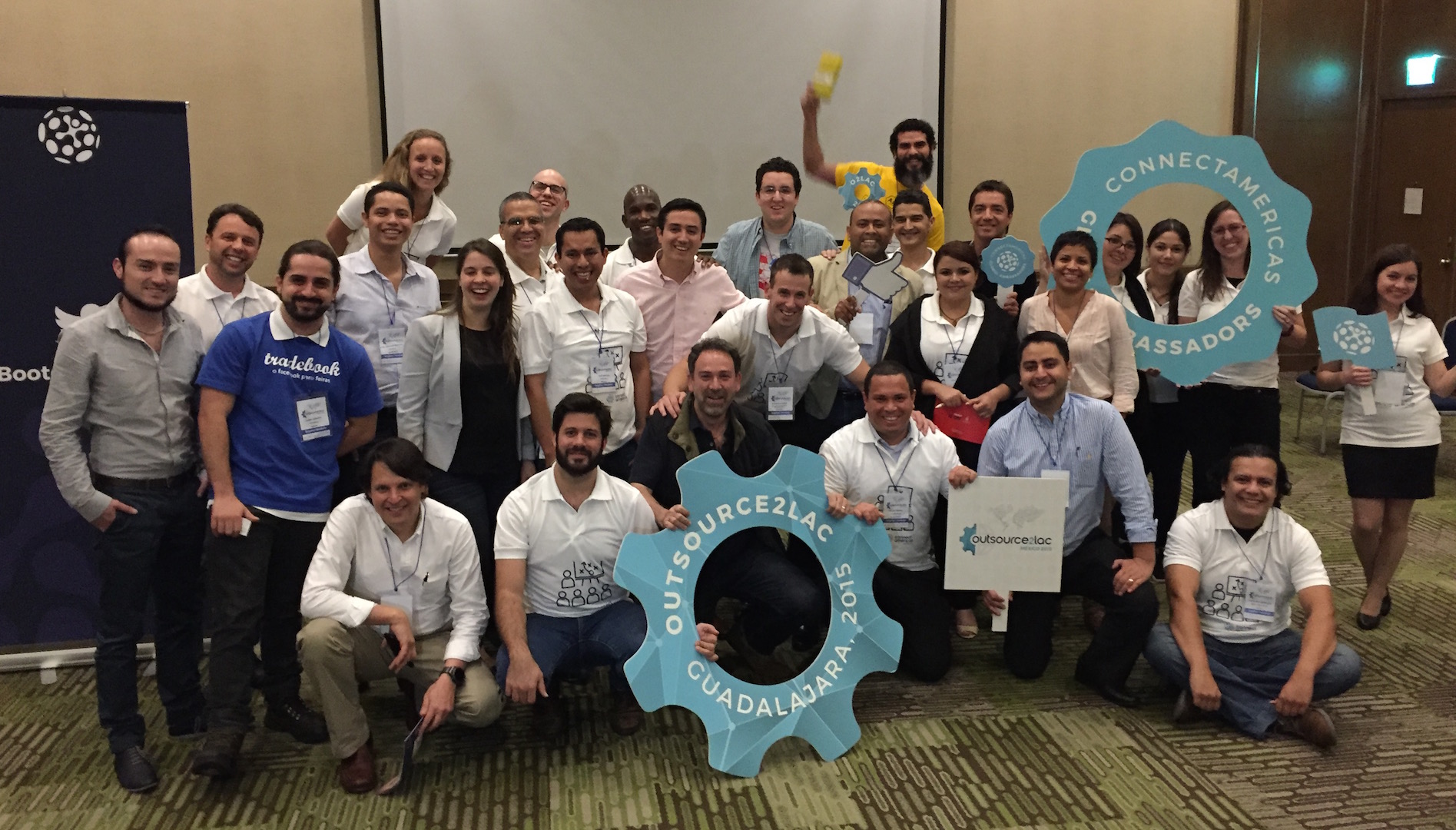
For the first time since ConnectAmericas was launched in March 2014, the platform organized a Bootcamp for entrepreneurs in Latin America and the Caribbean. It was a special training in areas such as Digital Marketing, Access to Finance, Entrepreneurial management, Innovation, Internationalization and Strategic Planning.
The moderators were Sebastián Spósito, from Google; Vicente Fenoll, from Kubo Financiero; Álvaro Dimitri Limberopulos, from Sumie Ideas; Pablo Larguía, from Red Innova; Dr. Laura Zapata, from EGADE Business School (TEC of Monterrey); Ady Beitler, from ConnectAmericas.com; and Esteban Guerrero, from Barbara & Frick.
In total, 29 companies participated: Azuan Technologies (Colombia), Creativa Consultores (El Salvador), Bullseye Soluciones Informáticas (Uruguay), IT Consulting (Chile), COCOMSYS (Nicaragua), EVICERTIA LATAM (Costa Rica), MiWeb (Costa Rica), Tradebook (Brazil), AnaliTIC (Chile), NAVITA Connect (Brazil), Harriague y Asociados/ IncluIT (Argentina), Saint Panamá (Panama), Influencia Digital (El Salvador), A1 Solutions (Jamaica) y Teleois Systems Limited (Trinidad & Tobago).
The following mexican enterprises also participated: PREPER DIGITAL SAPI DE CV., Cataranita, Aseo Xpress, Epic Queen, Tumbiko Joyeria Artesanal Mexicana, Tridi, Experiencia en Impresión 3D, Jenmi - Varowallet Zmart, Biopoop, Clouddemy, Vive Cafeto, Groomich, Lo Mero Nuestro, Ranktab and Lluvia Sólida.
- What benefits did companies gain from the Bootcamp? They received financial assistance to cover travel costs (airfare and hotel) to participate in the Bootcamp and Outsource2LAC. They also participated in one to one business rounds with global services investors, buyers and vendors during the conference. They also became ConnectAmericas Global Ambassadors for 2016.
- What were the benefits for the ConnectAmericas Global Ambassadors? The ConnectAmericas Global Ambassadors (CGA) obtained the following benefits: financing to cover travel costs (airfare and hotel) in one of the annual events organized by ConnectAmericas –LACFLavors, Asia-LAC Business Summit, Outsource2LAC- during 2016, recognition on the ConnectAmericas website through a placement in the home page and mentions in the “company of the month” campaign. In return, CGAs are expected to participate actively in ConnectAmericas through its communities and blog, and promote ConnectAmericas though its communication platforms.
- How were the companies chosen to participate in the Bootcamp and the 2016 CGAs? Participants were chosen by ConnectAmericas according to the following criteria: feasibility and potential of their international expansion strategy, innovative ability, and their contribution to regional integration in the global services sector.

Comments
Standards or Rules? The US
Standards or Rules? The US-China dispute over intellectual property infringement
The matter of hacking with the intent of gaining commercial advantages forms only a part of the larger dispute between China and the US over infringements of intellectual property and the regulation of creative works. Arguably, the adoption by the US of an open-ended discretionary standards approach and the limited application of the provisions of the Berne Convention provide a pretext for China's expansive and liberal interpretation of copyright law. This contrasts with the EU's Enumerated Exceptions (or Rule-based) orientation about which more will be said hereunder, using the 'Fair Use' principle as a point of illustration. .
Fair Use in the US
In the US the Fair Use Doctrine is codified, for the most part, in Title 17 of the United States Code (hereinafter “17 U.S.C”.) Section 107 (hereinafter “§107”). In these circumstances, the provisions of §107 permit the fair use of a copyrighted work for the explicit purposes of criticism, commentary, news reporting, teaching, scholarship or research.
Against this backdrop, the statute sets out a number of criteria necessary to justify the application of the fair use principle. They are: (i) the purpose and character of the use and, importantly, whether it is for commercial or not-for-profit educational purposes; (ii) the specific nature of the copyrighted work; (iii) the quantity and substantiality of the portion borrowed from the copyrighted work as a whole; and (iv) the impact the use is likely to have on the potential market or value of the copyrighted work.
Of particular importance to our discussion also are §113(a) and §113(c) which, taken together, carve out an exception for the making, distribution or display of pictures or photographs of pictorial, graphic or sculptural works that are lawfully reproduced in useful articles and distributed or displayed in connection with advertisements or commentaries or in connection with news reports.
The inescapable inference to be drawn, therefore, is that the US adopts an Open-Ended, Discretionary Standards Approach that essentially confers on judges (and other public officials) considerable power to decide whether a given ostensibly infringing activity should be privileged. This, judges do after taking various factors into account, in effect demonstrating that Courts have the responsibility to assess, on an ad hoc basis, defendants’ assertions that they should be excused for making unauthorised uses of copyrighted works.
Simply put, Fair Use represents a type of legal norm commonly known as a standard and makes direct reference to policy objectives, thus leaving judges (or other officials) a lot of latitude in deciding how best to achieve those policy objectives when resolving particular disputes.
Bemusedly, the US currently has no requirement that the defendant acknowledge that he is taking material from the plaintiff. Small wonder, therefore, that many defendants who have given the plaintiff no credit whatsoever have successfully invoked the Fair Use defence in the US. It should be clear by now that the Principle of Attribution is applied grudgingly in the US and there is an historical twist to this. While the Berne Convention recognises the legal protection of an author’s “moral rights”, the US did not join the Berne Convention until 1988 when it did so in a rather limited way.
Enumerated Exceptions in the EU
In contrast, the EU adopts an Enumerated Exceptions Approach that is codified in EU Article 5 of Directive 2001/29/EC; “The Harmonisation of Certain Aspects of Copyright and Related Rights in the Information Society”; May 2001. The governing principle is that the legislature should anticipate and provide for, in advance, all circumstances in which unauthorised uses should be permitted.
In terms of its operationalisation, Article 5 identifies one exception (Article 2) that Member States must adopt and a long list of exceptions that they may adopt. More specifically, Article 2 (Reproduction Right) mandates that “Member States shall provide for the exclusive right to authorise or prohibit direct or indirect, temporary or permanent reproduction by any means and in any form, in whole or in part: (i) for authors, of their works; (ii) for performers, of fixations of their performances; (iii) for phonogram producers, of their phonograms; (iv) for the producers of the first fixations of films, in respect of the original and copies of their films; and (v) for broadcasting organisations, of fixations of their broadcasts, whether those broadcasts are transmitted by wire or over the air, including by cable or satellite”. It is worth mentioning that under Article 5, Member States may not adopt Open-Ended, Discretionary Standards such as the US approach.
Basically, the Enumerated Exceptions Approach is a type of legal norm typically referred to as a Rule. In this sense, it constrains discretion by requiring judges (or other officials) to respond in a determinate way to specific sets of readily ascertainable variables.
A rather important nuance that sets the EU Approach in sharp contrast to that of the US is the application of the Principle of Attribution which in the EU is treated as a form of “moral right”. To illustrate the point, Article 5.3 (a) refers to “the use for the sole purpose of illustration for teaching or scientific research, as long as the source, including the author’s name, is indicated, unless this turns out to be impossible and to the extent justified by the non-commercial purpose to be achieved”. Interestingly, uses for the purpose of parody or caricature that escape liability in the US on Fair Use grounds find their way in Article 5.3(k) of the EU list: “use for the purpose of caricature, parody or pastiche”.
As the US-China dispute over intellectual property infringement lingers, it not only threatens to descend into a nasty spat of arrests and counter-arrests, but could also ultimately undermine the trans-pacific ecosystem for the production and regulation of creative works. Thus, the US should seize the initiative by moving promptly to explore ways of graduating from an open-ended discretionary standards approach to a more nuanced enumerated exceptions orientation better suited to the strategic priorities of a twenty-first century intellectual property architecture.